Slides for class

Slides ready to project: each problem is posed on one slide and solved on the next, with animations and teacher notes. They open in the browser, with nothing to download or install.

In the slides: arrow keys or click to move on, F full screen, N teacher notes.

For teachers only

The slides open with a teacher account. Signing up is free and also gives you groups, competitions and tracking of your students in the labs.

Combinatorics

Volume II · Binomial coefficients For teachers only

Combinatorics Almanac

Volume II · Binomial coefficients

Ages 14–15 Ages 15–16

Ana’s routes (a Gardner problem), the sum rule, Pascal’s triangle, bijections and binomial coefficients, with their formula and two proofs of Pascal’s rule.

27 slides · 3 animations
Volume III · Place your bets For teachers only

Combinatorics Almanac

Volume III · Place your bets

Ages 14–15 Ages 15–16

Classic bets to vote on before calculating: the Chevalier de Méré, Galileo’s three-dice problem, the birthday problem, the lottery against 24 heads, Newton and Pepys, and Pascal and Fermat’s problem of points.

27 slides · 4 animations

Volume IV · Balls, boxes and teams For teachers only

Combinatorics Almanac

Volume IV · Balls, boxes and teams

Ages 15–16 Ages 16–18

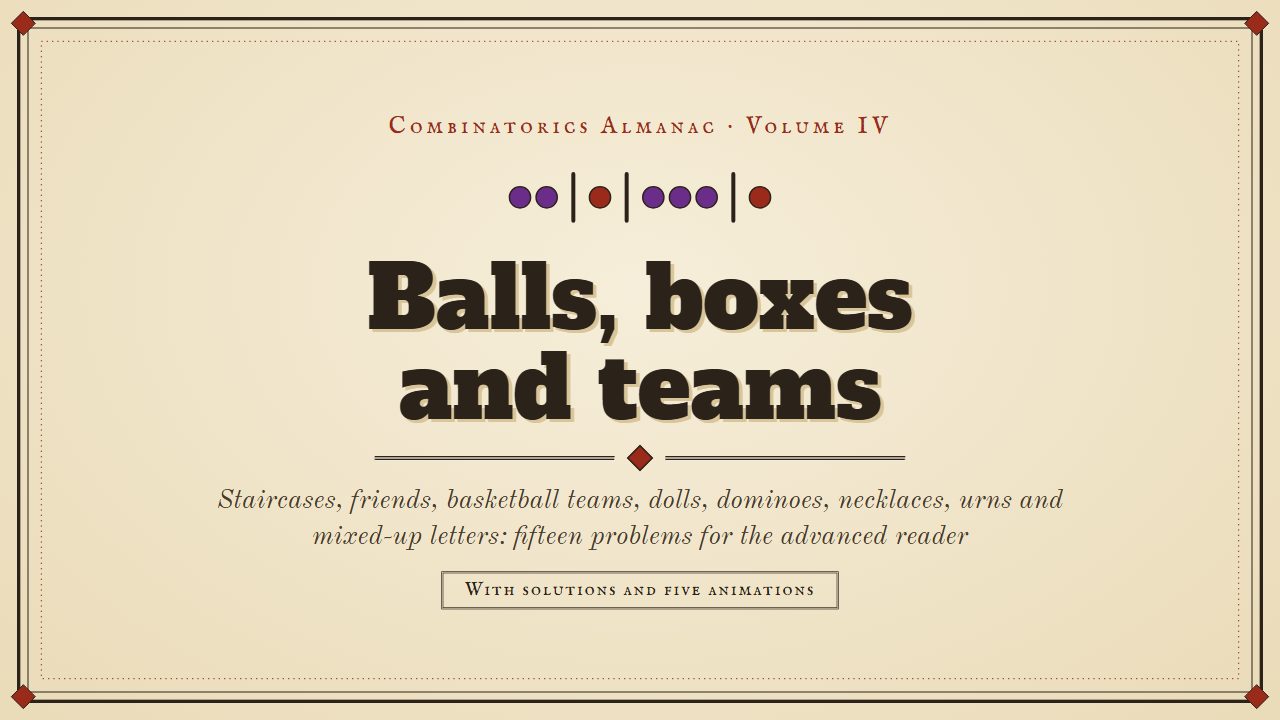
Fifteen problems for the advanced reader: Marta’s staircase, teams without colours, Magda’s dolls, the hockey stick, dominoes, balls and dividers, Anita’s necklace, the urn with nine balls and the absent-minded secretary. Each problem is posed on one slide and solved on the next.

36 slides · 5 animations

Probability

Volume III · Place your bets For teachers only

Combinatorics Almanac

Volume III · Place your bets

Ages 14–15 Ages 15–16

Classic bets to vote on before calculating: the Chevalier de Méré, Galileo’s three-dice problem, the birthday problem, the lottery against 24 heads, Newton and Pepys, and Pascal and Fermat’s problem of points.

27 slides · 4 animations

Notebook 1 · Geometric probability For teachers only

Chance lab

Notebook 1 · Geometric probability

Ages 15–16 Ages 16–18

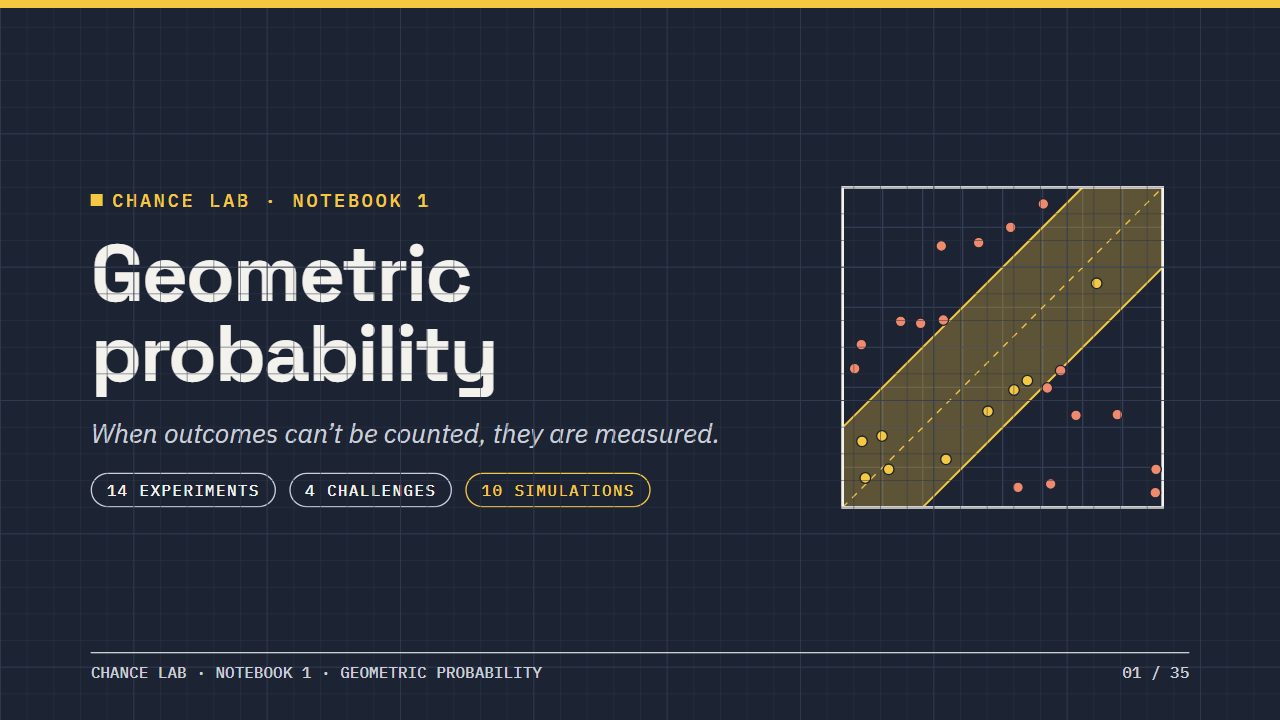
When outcomes cannot be counted, they are measured. The alarm clock, the cut ribbon, the square of pairs (the meeting, the cinema), the stick broken in three, points on a circle, Sylvester’s problem and Buffon’s needle.

35 slides · 10 animations

Notebook 2 · Paradoxes For teachers only

Chance lab

Notebook 2 · Paradoxes

Ages 15–16 Ages 16–18

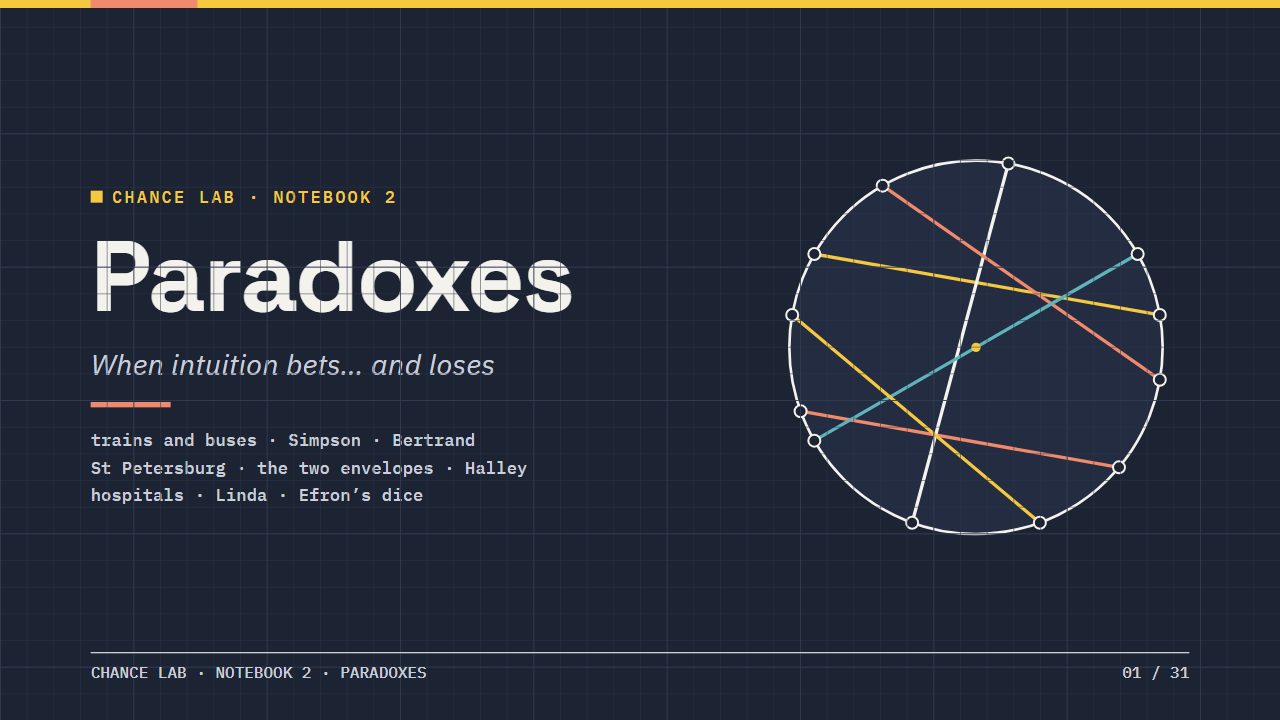
Predict before calculating. The two trains and the waiting time, Simpson, Bernstein’s independence, Secret Santa, Bertrand, St Petersburg, the two envelopes, the hospital, Linda, Efron’s dice and the surprise exam.

31 slides · 6 animations

Notebook 3 · Conditional probability For teachers only

Chance lab

Notebook 3 · Conditional probability

Ages 15–16 Ages 16–18

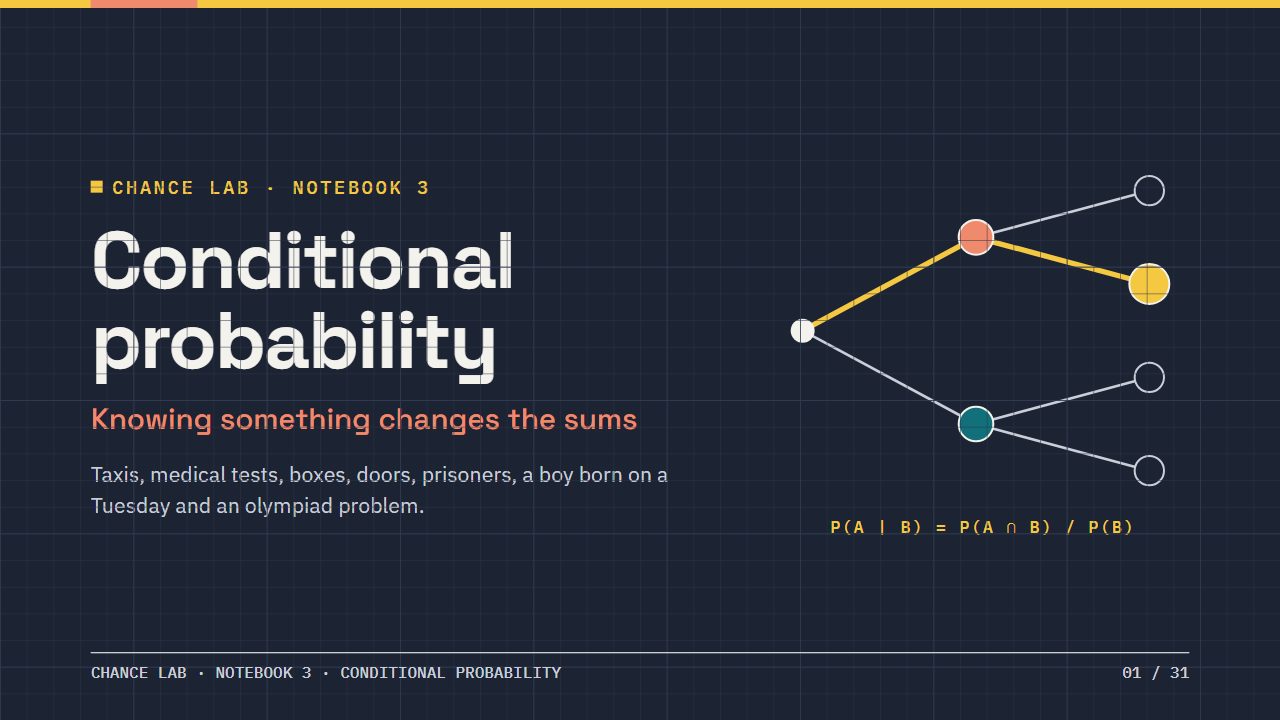
Conditioning means counting again among the cases that remain. Tables and trees, the taxi and the virus test (the base rate), Bertrand’s boxes, Monty Hall, the three prisoners, the boy born on a Tuesday and the hats.

31 slides · 4 animations